Strategies & Risk
How to Stop a Deriv Bot Losing Money With Risk Controls
Set a hard stop loss below 20% of your balance and cap multiplier progressions to learn how to stop a deriv bot losing money using 5 setup steps.
The safest money management for binary bots on Deriv synthetic indices is a strict Fixed Stake model combined with a 20% stop loss and a 10% take profit / target profit limit. Instead of multiplying your stake after a loss to chase equity, you keep your entry size fixed at 1% or 2% of your account balance. This keeps your account safe during bad statistical streaks, ensuring a losing run takes down only a tiny, predictable fraction of your capital rather than triggering a complete balance wipeout.
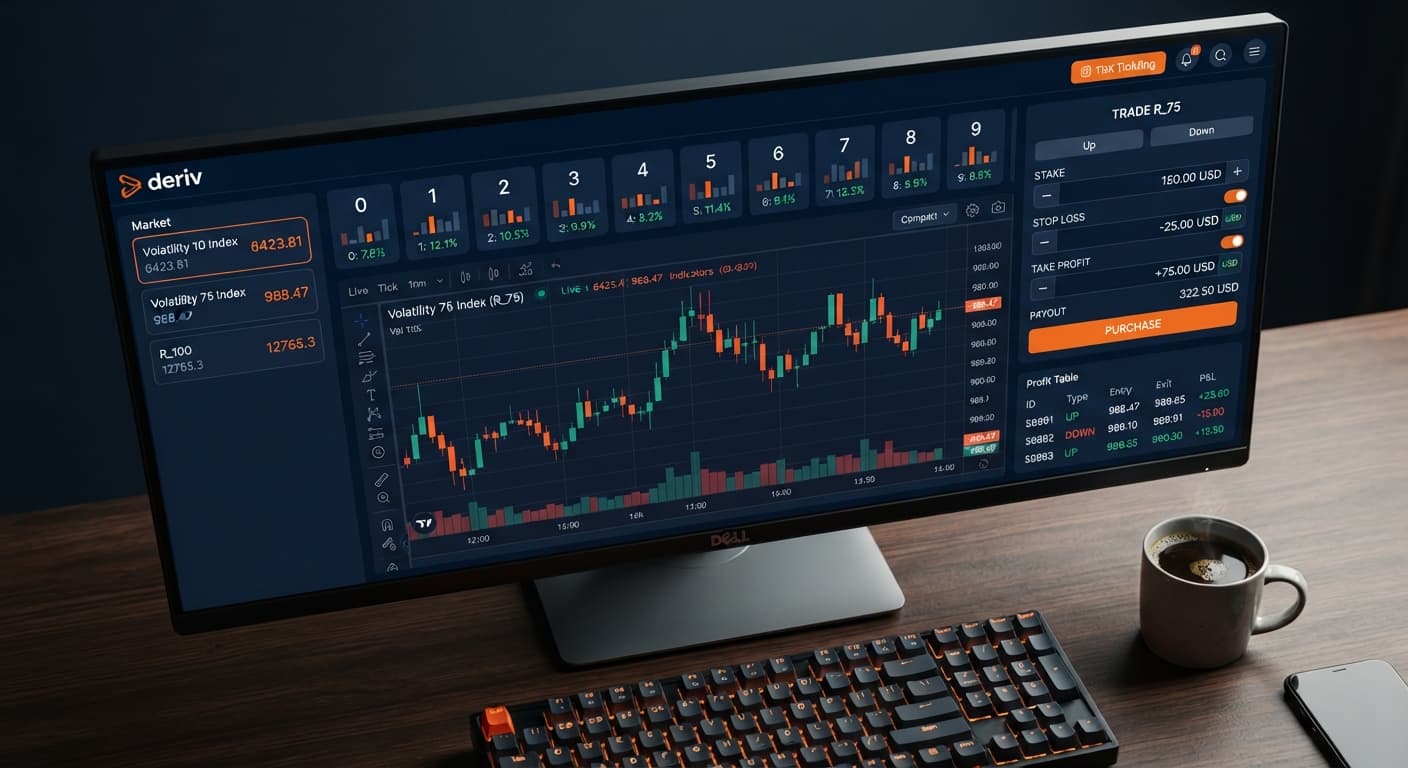
When you run automated setups on synthetic index markets like Volatility 75 or Volatility 100, you're placing high-speed bets on the final decimal digit of an algorithmic price tick. These price ticks update every single second. You aren't purchasing underlying assets or holding open positions across hours—you're executing short-duration digital contracts.
On automated tools found in the free bot library, traders run strategies across six core digit contract types:
Every single tick generated by Deriv synthetic indices is completely independent of the previous tick. A run of six consecutive even digits does not mean an odd digit is due next. Because past digits have zero influence on future ticks, you can't rely on pattern hunting to save your account balance. Your real survival depends entirely on how your money management rules handle unexpected losing runs when market distribution swings against you.
Most automated traders who blow their accounts do so because they rely on negative stake progressions like Martingale, Fibonacci, or D'Alembert. When your bot hits a cluster of consecutive losses, these progression systems double or triple your next stake to recover previous losses in one shot. A single extended bad run forces your bot to risk your entire remaining account on one tick.
Fixed Stake removes that hazard completely. When you select Fixed Stake on tools like the Solid Trading Bot, your order size stays identical on every single contract. Whether your last trade was a winning tick or a losing tick, your next trade costs the exact same dollar amount.
This brings three concrete operational advantages:
Fixed Stake isn't financial advice, and it won't magically turn a losing entry rule into a winning one. What it does is keep you alive in the market long enough for statistical probabilities to smooth out.
To see why Fixed Stake is the safest money management for binary bots, compare it directly against a standard Martingale progression during a losing streak.
Assume you start trading with a $100 demo balance on Volatility 75 Index placing DIGITEVEN contracts. Your base stake is $2. DIGITEVEN pays roughly 95% net return on winning contracts (a $2 stake returns $3.90 total, which is $1.90 net profit).
Here is the exact progression across five consecutive losses:
| Trade # | Contract Result | Fixed Stake Amount | Fixed Balance | Martingale Stake (2x) | Martingale Balance |
|---|---|---|---|---|---|
| Start | - | - | $100.00 | - | $100.00 |
| Trade 1 | Loss | $2.00 | $98.00 | $2.00 | $98.00 |
| Trade 2 | Loss | $2.00 | $96.00 | $4.00 | $94.00 |
| Trade 3 | Loss | $2.00 | $94.00 | $8.00 | $86.00 |
| Trade 4 | Loss | $2.00 | $92.00 | $16.00 | $70.00 |
| Trade 5 | Loss | $2.00 | $90.00 | $32.00 | $38.00 |
| Trade 6 | Pending | $2.00 | $88.00 remaining | $64.00 | Insufficient Funds |
Look at what happens on Trade 6 for the Martingale run. After five losses in a row, the Martingale strategy has already drained $62.00 from your balance. To enter Trade 6, the bot attempts to place a $64.00 stake. Because your remaining balance is only $38.00, Deriv rejects the trade due to insufficient funds. Your account is broken, and you can't place the recovery trade.
Under Fixed Stake, those same five losses cost you only $10.00 total. Your account balance sits safely at $90.00. You still have 45 full trades of margin remaining to recover naturally without risking your remaining capital.
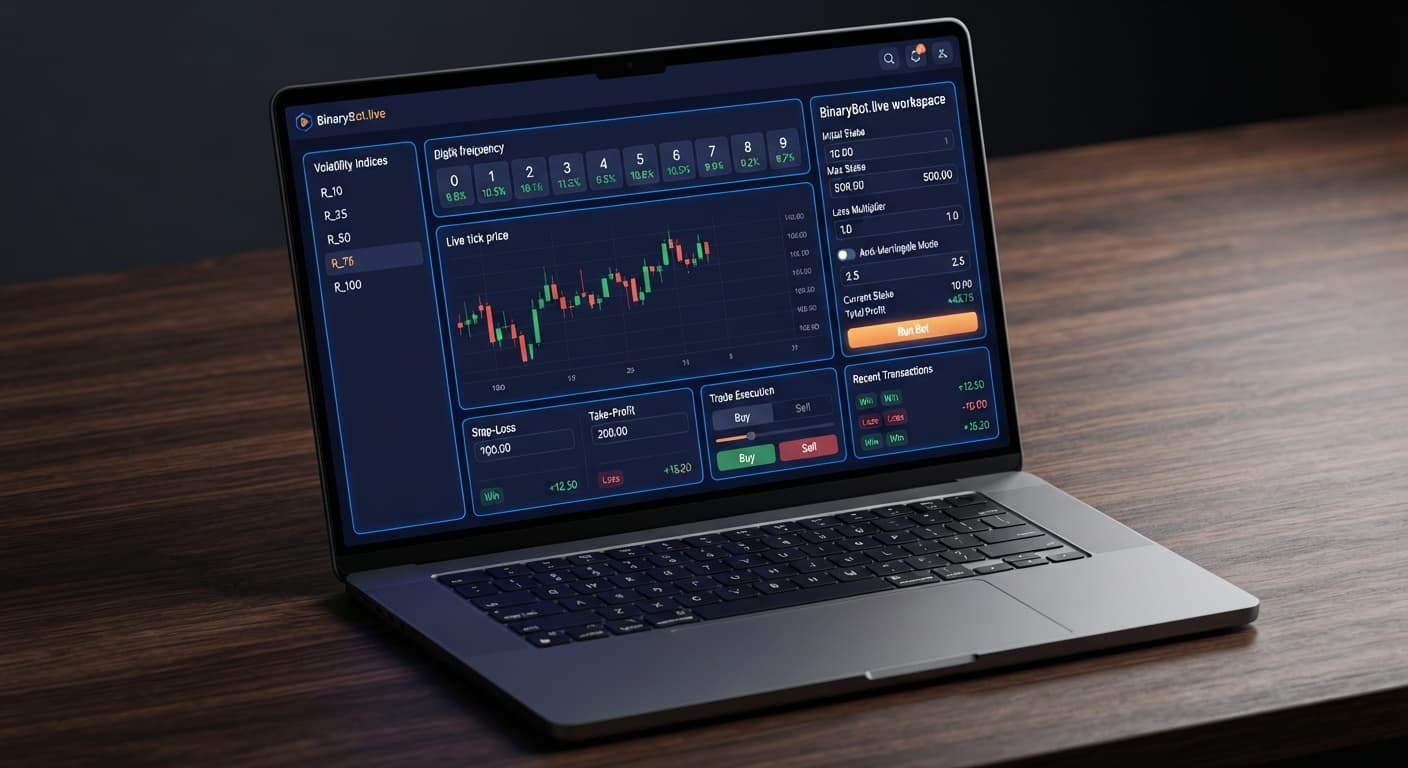
Configuring strict risk rules takes less than a minute when using automated options like the AutoPilot bot or analyzing digit trends via the LDP Analyzer Pro dashboard. The platform connects straight to Deriv over their official API using your own API token, meaning no funds ever touch BinaryBot.live servers.
Follow these step-by-step instructions to set up your safe trading parameters:
Open your chosen tool on BinaryBot.live and paste your API token into the connection field. Always start on a Deriv demo account to test your configuration before committing real money.
In the Money Management options menu, select Fixed Stake. Avoid choosing Martingale, Anti-Martingale, Fibonacci, D'Alembert, % of Balance, Mesamilano, or Multi Shot's Recovery if your primary goal is protecting your balance from sharp drawdowns.
Set your Base Stake to between 1% and 2% of your starting account balance. If your account holds $100, set your stake to 2. If you hold $500, set your stake to 5 or 10.
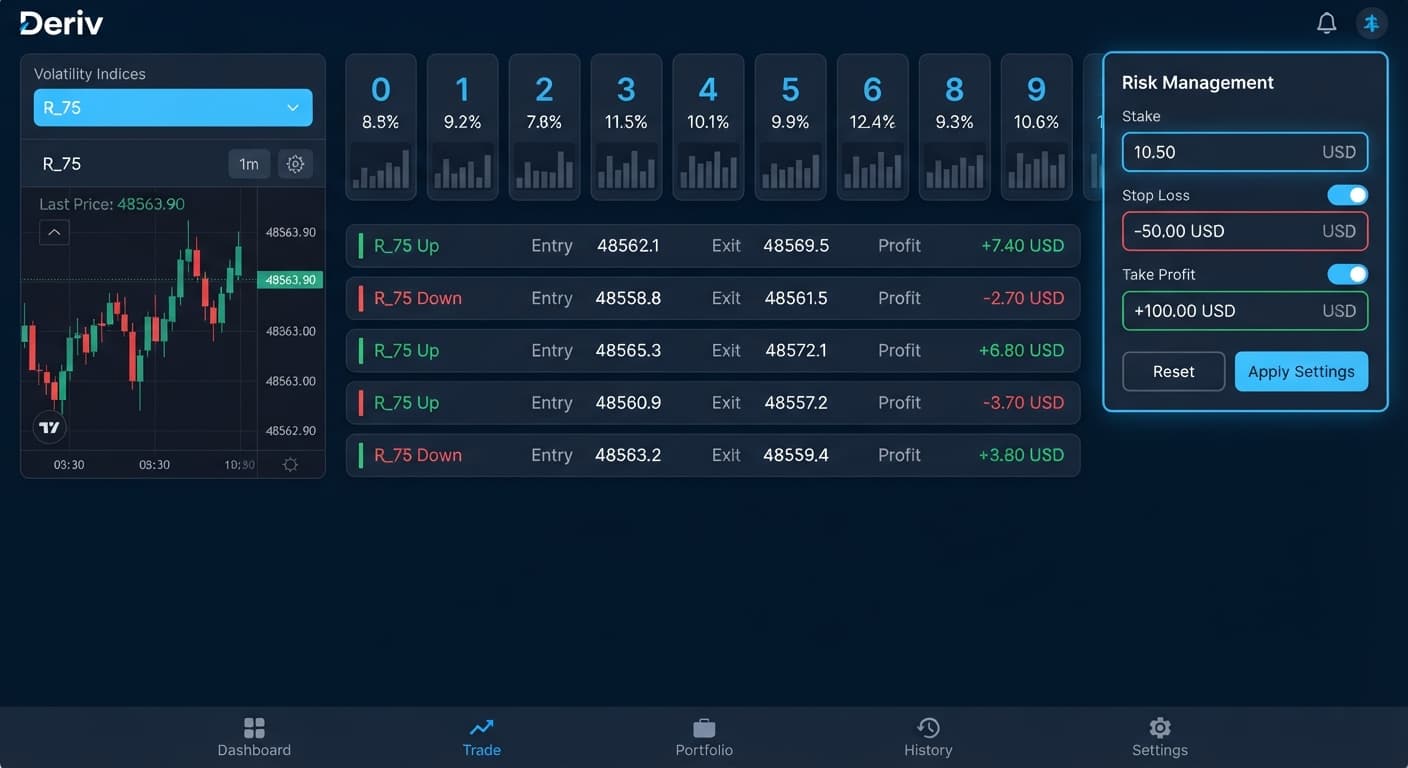
Input clear monetary limits in the risk control fields:
20. If your session losses reach $20, the bot stops trading instantly.10 on a $100 balance). The moment your bot hits $10 in cumulative session profit, it shuts down and locks in your gains.3 or 4. When using Fixed Stake, this field remains inactive because your stake never steps up.Pick your synthetic index market (e.g., Volatility 10, 25, 50, 75, or 100) and choose your target contract type—DIGITEVEN, DIGITODD, DIGITOVER, DIGITUNDER, DIGITMATCH, or DIGITDIFF. Hit start and let the bot automate entries under your strict stake limits.
While Fixed Stake is the safest money management for binary bots from a risk perspective, it's not a shortcut to easy profits. It has clear trade-offs that every trader must understand before running live automated bots.
Fixed Stake demands that your underlying binary bot trading strategy holds a genuine win-rate advantage. On standard DIGITEVEN or DIGITODD contracts paying around 95%, you need a win rate above 51.3% over a large sample of trades just to stay positive after Deriv's built-in contract pricing. If your trade logic delivers only a 48% win rate, Fixed Stake won't make you profitable—it will simply drain your account slowly over hundreds of trades instead of wiping you out in ten minutes.
The drawback is even more visible on DIGITDIFF contracts. Because DIGITDIFF pays small returns (around 9.9%), a single loss wipes out roughly ten previous wins. If your bot hits two consecutive losses on DIGITDIFF, recovering those losses using Fixed Stake takes 20 winning contracts in a row.
If you don't have the discipline to accept slow equity growth, or if your binary trading strategy depends on fast multiplier spikes to bounce back from drawdowns, pure Fixed Stake will feel frustratingly slow. But if your goal is long-term survival, stress-free automation, and protecting your capital against catastrophic losses, combining Fixed Stake with hard stop loss and take profit / target profit controls is the single best approach on Deriv.
Try the settings yourself on the Solid Trading Bot using a demo balance first. If you don't have an account yet, create a free Deriv account to begin testing.
Trading involves risk. Past performance does not guarantee future results.
Related: How to Stop a Deriv Bot Losing Money With Risk Controls
Related: Deriv Bots Stake Size Guide: Fixed, % and Martingale Setup
Related: Configuring the Digit Differs Bot for Anti-Martingale
How the strategies behind the bots actually work — Digit Differs, Over/Under, Even/Odd, Rise/Fall, and the money management that decides whether they survive a losing streak.
Try 9 Strategies on Solid →The safest approach is a strict Fixed Stake model combined with a 20% stop loss and a 10% take profit limit. You keep your entry size at 1% or 2% of your account balance rather than multiplying stakes after a loss.
Traders usually blow their accounts by using negative stake progressions like Martingale, Fibonacci, or D'Alembert. These systems multiply the stake after a loss, forcing an extended bad run to risk the entire remaining account on a single tick.
No, every single tick generated by Deriv synthetic indices is completely independent of the previous tick. Past digits have zero influence on future ticks, meaning you cannot rely on pattern hunting.
Martingale doubles or triples your stake after a loss to recover previous funds, which can quickly burn through capital during a bad streak. Fixed Stake keeps your order size identical on every single contract regardless of whether the last trade won or lost.
Guides closest to this one.
Set a hard stop loss below 20% of your balance and cap multiplier progressions to learn how to stop a deriv bot losing money using 5 setup steps.
Configure the DIGITDIFF bot for Anti-Martingale by setting a win multiplier, defining a max ladder level, and protecting your session with stop loss limits.
Use Fixed Stake, % of Balance, or Martingale with a strict max ladder level. This deriv bots stake size guide covers how to set automated risk controls.